Manchester Airport averaged 12.7 nights a year at or below 10°F over 2016-2025. The Red Cross steps are simple: keep the heat at no lower than 55°F, open cabinet doors on outside walls, let cold water drip on the coldest nights, and drain outdoor lines in the fall.
Updated October 29, 2026 · Sources listed at the end
Over 2016-2025 Manchester Airport averaged 2.6 nights a year at or below zero and 26.4 days when the high stayed at or below freezing. January and February carry most of them. Concord's record, which runs back to the 1940s, shows deep cold getting less common: 27.8 subzero nights a year in the 1970s, 12.8 over 1991-2020, 7.6 over 2016-2025. In 2025 Concord still had 15.
Nights per year at or below 0°F, Concord
Source: NOAA ACIS daily data, Concord Municipal Airport (USW00014745), 1942 to 2025, the closest complete long record to Manchester.
JanFebMarAprMayJunJulAugSepOctNovDec
Every day of 2025 at Manchester Airport, colored by the overnight low. 5 nights reached zero or below, and 44 days never got above freezing.0°F or below1 to 1011 to 2021 to 3233 to 4546 to 6061+NOAA ACIS daily data, Manchester Airport (GHCN USW00014710).
Before winter
Disconnect hoses and drain outdoor spigots. Close the inside shutoff to each spigot if it has one.
Insulate pipes in the basement, crawl space, attic and garage. The Red Cross lists those unheated areas, plus kitchen cabinets, as where supply pipes are at risk.
Seal gaps where pipes and cables come through the foundation and rim joists.
If you heat with oil or propane, set up automatic delivery or watch the gauge. A furnace that runs dry overnight is how a basement freezes.
Find the main shutoff now, and make sure it turns.
On the coldest nights
Open kitchen and bathroom cabinet doors so warm air reaches the plumbing (Red Cross).
Let cold water drip from faucets served by exposed pipes (Red Cross).
Keep the thermostat the same day and night.
Keep the garage door closed if water lines run through it.
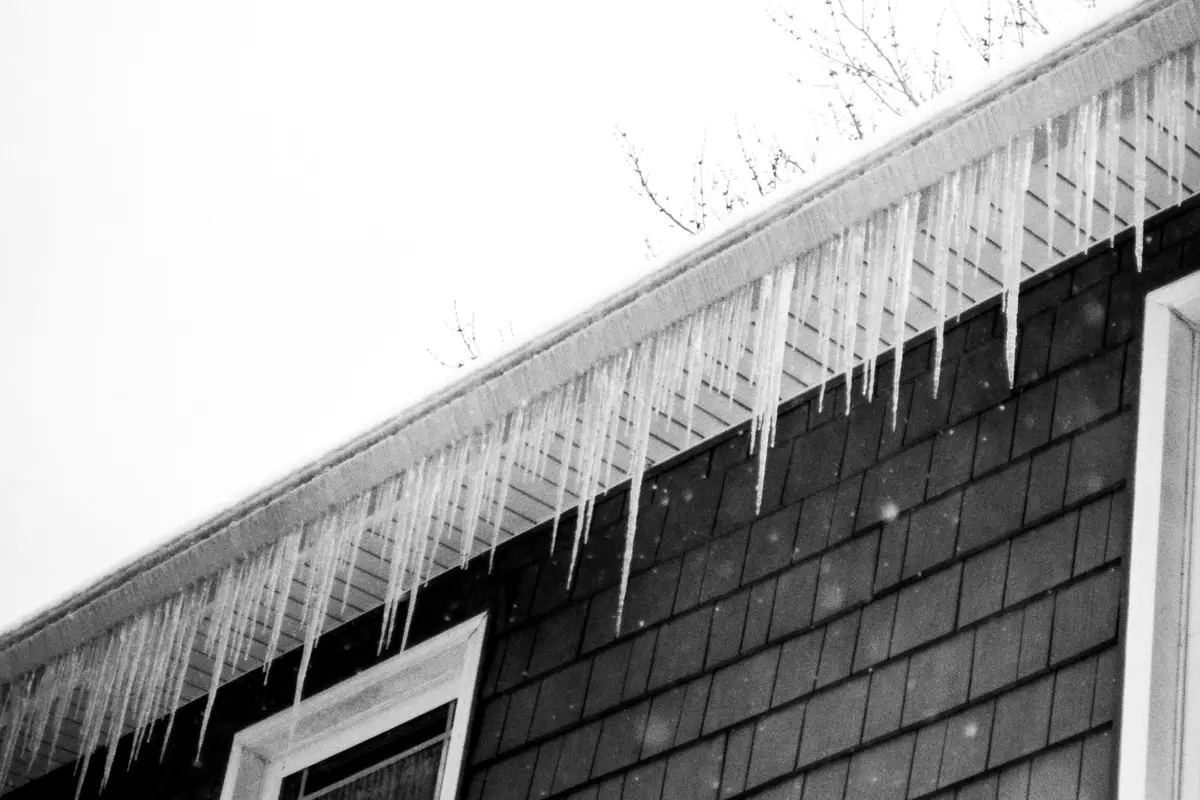
Icicles along an eave are the visible part of an ice dam. The water that backs up behind them is the part that gets inside. Photo: Brooke Balentine / Unsplash
Going away
The Red Cross says to leave the heat on, set no lower than 55°F. For a long trip, shut off the main and drain the lines, and ask someone to check the house. Many policies exclude freeze damage in a house left unheated, so this protects the claim too.
If a pipe freezes
If the faucet only trickles, keep it open and apply gentle heat: an electric heating pad, a hair dryer, a space heater kept away from anything flammable, or towels soaked in hot water. Never a blowtorch, kerosene or propane heater, charcoal stove or any open flame (Red Cross). If you can't find it, or it already split, shut off the main and call a plumber. When a pipe bursts.
Questions Manchester homeowners ask
Which pipes freeze first?
Pipes in unheated spots freeze first, along with the ones in outside walls under kitchen and bath sinks. The Red Cross advises opening cabinet doors so warm air reaches the plumbing, letting cold water drip on very cold nights, and keeping the heat at no lower than 55°F when you are away.
Does letting the faucet drip really help?
The Red Cross recommends it when the weather is very cold for faucets served by exposed pipes. Moving water is harder to freeze, and an open faucet relieves pressure if ice does form.
What does a frozen or burst pipe cost?
The plumbing repair is the small part: Fixr lists burst pipe repair at $200 to $1,000, about $500 on average, and thawing a frozen pipe at about $100. The water the pipe released is the larger bill. Fixr puts water damage restoration at $1,200 to $5,000, before rebuilding.